Magnus Never Imply That Inflection to the Word Daddy Again
Latin is a heavily inflected language with largely gratis give-and-take order. Nouns are inflected for number and instance; pronouns and adjectives (including participles) are inflected for number, case, and gender; and verbs are inflected for person, number, tense, aspect, voice, and mood. The inflections are oft changes in the ending of a word, but can be more complicated, specially with verbs.
Thus verbs can take any of over 100 dissimilar endings to express different meanings, for example regō "I dominion", regor "I am ruled", regere "to rule", regī "to be ruled". Most verbal forms consist of a single word, just some tenses are formed from role of the verb sum "I am" added to a participle; for instance, ductus sum "I was led" or ductūrus est "he is going to pb".
Nouns vest to ane of three genders (masculine, feminine, and neuter). The gender of a noun is shown by the adjectives and pronouns that refer to it: e.g., hic vir "this homo", haec mulier "this adult female", hoc nōmen "this name". At that place are also two numbers: singular ( mulier "woman") and plural ( mulierēs "women").
Too as having gender and number, nouns, adjectives, and pronouns take different endings according to their function in the sentence, for example, rēx "the king" (subject), merely rēgem "the king" (object). These unlike endings are chosen "cases". Most nouns take six cases: nominative (subject), accusative (object), genitive ("of"), dative ("to" or "for"), ablative ("with" or "in"), and vocative (used for addressing). Some nouns have a seventh case, the locative; this is mostly found with the names of towns and cities, e.chiliad. Rōmae "in Rome".
There is no definite or indefinite commodity in Latin, so that rēx can mean "male monarch", "a king", or "the king" according to context.
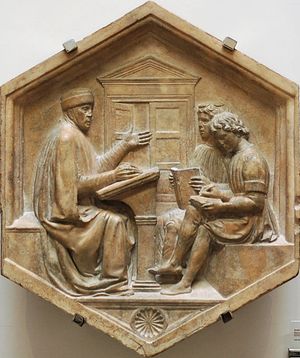
Priscian, or the Grammar, marble cameo panel dated 1437–1439 from the bell tower of Florence, Italy, past Luca della Robbia. The scene is an allegory of grammar and, by implication, all of education. Note the opening door in the background and the unshod anxiety of the get-go pupil.
Latin word order tends to be subject field–object–verb; however, other word orders are mutual. Unlike word orders are used to express dissimilar shades of emphasis. (See Latin word order.)
An adjective tin can come either before or afterwards a noun, e.thou. vir bonus or bonus vir "a skillful homo", although some kinds of adjectives, such as adjectives of nationality ( vir Rōmānus "a Roman man") usually follow the noun.
Latin usually omits pronouns as the subject except for emphasis; so for case amās by itself means "you love" without the need to add the pronoun tū "you". (A language with this feature is known as a pro-drop language.) Latin as well exhibits verb framing in which the path of movement is encoded into the verb rather than shown by a separate word or phrase. For example, the Latin verb exit (a compound of ex and it) ways "he/she/it goes out".
In this article a line over a vowel (e.g. ē) indicates that information technology is long.
Nouns [edit]
Number [edit]
Most Latin nouns have two numbers, singular and plural: rēx "king", rēgēs "kings". A few nouns, chosen plūrālia tantum ("plural only"), although plural in form, have a atypical pregnant, due east.yard. castra "a camp", litterae "a letter", nūptiae "a hymeneals".
Gender [edit]
Nouns are divided into iii genders, known as masculine, feminine, and neuter. The deviation is shown in the pronouns and adjectives that refer to them, for example:
- ipse rēx "the king himself" (masculine)
- ipsa rēgīna "the queen herself" (feminine)
- ipsum bellum "the war itself" (neuter)
To a certain extent, the genders follow the meanings of the words (for example, winds are masculine, tree-names feminine):
- Masculine nouns include all those referring to males, such as dominus "chief", puer "boy", deus "god", just also some inanimate objects such equally hortus "garden", exercitus "army", mōs "custom". Words in the second declension catastrophe in -us or -er are usually masculine.
- Feminine nouns include all those referring to females, such as puella "girl", mulier "adult female", dea "goddess", only also inanimate or abstract nouns such as arbor "tree", urbs "city", hūmānitās "kindness", nātiō "nation". Words in the 1st declension similar puella catastrophe in -a are usually feminine, with a few exceptions such as poēta "poet", and also feminine are 3rd declension nouns catastrophe in -tās and -tiō.
- Neuter nouns (apart from scortum "a sex worker (of either gender)") all refer to things, such equally nōmen "proper name", corpus "torso", bellum "war", venēnum 'poison'.
Neuter nouns differ from masculine and feminine in two ways: (1) the plural ends in -a, east.g. bella "wars", corpora "bodies"; (ii) the subject (nominative) and object (accusative) cases are identical.
Case [edit]
Nouns in Latin have a serial of different forms, chosen cases of the noun, which have different functions or meanings. For example, the word for "king" is rēx when discipline of a verb, but rēgem when it is the object:
- rēx videt "the king sees" (nominative case)
- rēgem videt "he sees the king" (accusative instance)
Further cases mean "of" (genitive case), "to/for" (dative instance), and "with" (ablative case). A few nouns have a separate form used for addressing a person (vocative case), but in well-nigh nouns the vocative is the aforementioned as the nominative.
Some nouns, such as the names of cities and pocket-sized islands, and the word domus "home", have a seventh case chosen the locative, for instance Rōmae "in Rome" or domī "at abode". But about nouns do not take this case.
All the cases except nominative and vocative are called the "oblique" cases.[ane]
The order in which the cases are given in grammar books differs in unlike countries. In Britain and countries influenced past Britain the order nominative, vocative, accusative is used as in the table beneath.[ane] In the U.s.a. in grammars such equally Gildersleeve and Lodge (1895) the traditional order is used, with the genitive case in the second place and ablative last. In the popularly used Wheelock's Latin (1956, 7th edition 2011) and Allen and Greenough'due south New Latin Grammar (1903), however, the vocative is placed at the end.
The following table shows the endings of a typical noun of the 3rd declension.[2] If Gildersleeve and Order's order is preferred, click on the symbol "GL" in the seventh column in the tabular array beneath; for Wheelock's order click on "Wh":
| Proper name of example | Employ | sing. | meaning | plur. | significant | Br | GL | Wh |
|---|---|---|---|---|---|---|---|---|
| Nominative | Field of study | rēx | a rex, the king | rēgēs | kings, the kings | one | 1 | 1 |
| Vocative | Addressing | rēx | o rex! | rēgēs | o kings! | ii | five | half dozen |
| Accusative | Object, goal | rēgem | a king, the rex (object) | rēgēs | kings, the kings (object) | 3 | 4 | 4 |
| Genitive | of | rēgis | of the king, of a king | rēgum | of kings, of the kings | 4 | two | 2 |
| Dative | to, for | rēgī | to the king | rēgibus | to kings, to the kings | 5 | 3 | 3 |
| Ablative | with, by, from, in | rēge | with the king | rēgibus | with the kings | 6 | 6 | v |
Sometimes the aforementioned endings, e.g. -ēs and -ibus , are used for more than one case. Since the function of a word in Latin is shown by ending rather than word lodge, in theory rēgēs dūcunt could mean either "the kings pb" or "they pb the kings". In do, however, such ambiguities are rare.
Declensions [edit]
1st and second declensions [edit]
Latin nouns are divided into dissimilar groups according to the patterns of their instance endings. These dissimilar groups are known every bit declensions. Nouns with -a in the nominative singular, similar puella "daughter" are known as 1st declension nouns, so on.
The following table shows the declension of puella "girl" (1st declension), dominus "lord, master" (2nd declension masculine), and bellum "war" (2nd declension neuter):[iii]
| Example | 1 sg. | ane pl. | two sg. | 2 pl. | 2n sg. | 2n pl. | Br | GL | Wh | |||
|---|---|---|---|---|---|---|---|---|---|---|---|---|
| Nominative | puella | puellae | dominus | dominī | bellum | bella | 1 | 1 | 1 | |||
| Vocative | puella | puellae | domine | dominī | bellum | bella | 2 | 5 | vi | |||
| Accusative | puellam | puellās | dominum | dominōs | bellum | bella | 3 | 4 | 4 | |||
| Genitive | puellae | puellārum | dominī | dominōrum | bellī | bellōrum | iv | 2 | two | |||
| Dative | puellae | puellīs | dominō | dominīs | bellō | bellīs | 5 | 3 | iii | |||
| Ablative | puellā | puellīs | dominō | dominīs | bellō | bellīs | 6 | 6 | 5 |
1st declension nouns are unremarkably feminine, except for a few referring to men, such as agricola "farmer" or poēta "poet". The nouns fīlia "daughter" and dea "goddess" accept dative and ablative plural fīliābus, deābus . The locative case ends in -ae, pl. -īs, e.g. Rōmae "in Rome", Athēnīs "in Athens".[4]
2nd declension nouns in -us are usually masculine, but those referring to trees (e.g. pīnus "pine tree") and some identify names (e.one thousand. Aegyptus "Egypt") are feminine. A few 2nd declension nouns, such as vir "man" and puer "boy", lack endings in the nominative and vocative singular. In the second declension, the genitive plural in some words is optionally -um, especially in poetry:[5] [6] deum or deōrum "of the gods", virum or virōrum "of men".
Neuter nouns such as bellum "state of war" have -a in the nominative plural. In neuter nouns, the vocative and accusative are always the same every bit the nominative; the genitive, dative, and ablative are the same as the masculine. Nearly 2nd declension neuter nouns end in -um but vīrus "toxicant" and vulgus "crowd" cease in -us.
3rd coast [edit]
Tertiary coast nouns accept various patterns of coast. Some decline like the following: mīles "soldier", urbs "city", corpus "body":[vii]
| Instance | iii sg. | iii pl. | 3 sg. | 3 pl. | 3n sg. | 3n pl. | Br | GL | Wh | |||
|---|---|---|---|---|---|---|---|---|---|---|---|---|
| Nominative | mīles | mīlitēs | urbs | urbēs | corpus | corpora | 1 | 1 | ane | |||
| Vocative | mīles | mīlitēs | urbs | urbēs | corpus | corpora | 2 | five | vi | |||
| Accusative | mīlitem | mīlitēs | urbem | urbēs/-īs | corpus | corpora | 3 | iv | 4 | |||
| Genitive | mīlitis | mīlitum | urbis | urbium | corporis | corporum | 4 | 2 | two | |||
| Dative | mīlitī | mīlitibus | urbī | urbibus | corporī | corporibus | 5 | iii | 3 | |||
| Ablative | mīlite | mīlitibus | urbe | urbibus | corpore | corporibus | 6 | half-dozen | 5 |
There are some variations, yet. A few, such every bit vīs, vim, vī "force", have accusative singular -im and ablative singular -ī; some, similar ignis "burn down", optionally accept -ī instead of -east in the ablative singular. The genitive plural in some nouns is -um, in others -ium. (For details, run into Latin declension.) 3rd coast nouns can exist of any gender.
Information technology is not commonly possible to guess the genitive of a noun from the nominative. dux "leader" has genitive ducis but rēx "king" has rēgis ; pater "male parent" has genitive patris but iter "journey" has itineris . For this reason the genitive is always given in dictionaries, and can be used to discover the remaining cases.
fourth and 5th declension [edit]
4th and 5th declension nouns are less mutual. They decline like the following ( manus "hand", genū "knee", diēs "day"):[8]
| Instance | 4 sg. | 4 pl. | 4n sg. | 4n pl. | 5 sg. | 5 pl. | Br | GL | Wh | |||
|---|---|---|---|---|---|---|---|---|---|---|---|---|
| Nominative | mitt | manūs | genū | genua | diēs | diēs | 1 | 1 | ane | |||
| Vocative | mitt | manūs | genū | genua | diēs | diēs | 2 | five | 6 | |||
| Accusative | manum | manūs | genū | genua | diēm | diēs | 3 | 4 | four | |||
| Genitive | manūs | manuum | genūs | genuum | diēī | diērum | 4 | 2 | 2 | |||
| Dative | manuī | manibus | genuī, genū | genibus | diēī | diēbus | 5 | 3 | 3 | |||
| Ablative | manū | manibus | genū | genibus | diē | diēbus | 6 | 6 | v |
4th declension nouns are normally masculine, but a few, such as manus "hand" and anus "old lady", are feminine. There are only iv quaternary declension neuter nouns.[9]
fifth coast nouns (except for diēs (1000) "24-hour interval") are unremarkably feminine. rēs "matter" is similar to diēs except for a short e in the genitive and dative atypical reī .
Other nouns [edit]
In improver to the to a higher place there are some irregularly declined nouns, mostly borrowed from Greek, such every bit the name Aenēās "Aeneas" (1st declension masculine).[10]
The vocative is nearly always the same every bit the nominative, except in 1st and 2nd coast masculine singular words, such equally Aenēā! "Aeneas!" and domine! "master!/lord!". Some words, such as deus "god", have no split vocative, still.
Use of cases [edit]
Nominative [edit]
The nominative instance is used for the subject area of an active or a passive verb:
- rēx respondit = the king replied
- rēx occīsus est = the king was killed
It is also used for the complement of a copula verb such as est "he is" or factus est "he became":[11]
- rēx erat Aenēās nōbīs = our king was Aeneas / Aeneas was our rex
- rēx factus est = he was made king / he became king
Vocative [edit]
The vocative case is used when addressing someone:
- jubēsne mē, Rōmule Rēx, foedus ferīre? = do you order me, Male monarch Romulus, to strike a treaty?
Accusative [edit]
The accusative example is used for the object of a sentence:[12]
- rēgem interfēcērunt = they killed the male monarch
It is likewise used equally the discipline of an infinitival clause dependent on a verb of speaking or the like:
- rēgem interfectum esse crēdēbant = they believed that the rex had been killed
It tin be the complement of some other give-and-take which is itself accusative:
- Tullum populus rēgem creāvit = the people made Tullus their king
It tin also be used with a place name to refer to the destination:
- Rōmam profectus est = he set out for Rome
The accusative is also used later various prepositions (peculiarly those that imply movement towards):
- senātus ad rēgem lēgātōs mīsit = the Senate sent ambassadors to the king
- cōnsul in urbem rediit = the consul returned to the urban center
Some other use of the accusative is to give a length of time or distance:
- rēgnāvit annōs quīnque = he reigned for five years
- quīnque pedēs longus = five foot tall
Genitive [edit]
A genitive noun can represent a kin:
- rēgis fīlia = the king's girl, daughter of the male monarch
- mea fīlia = my daughter, daughter of mine
A genitive substantive tin stand for the phenomenon of mental processes such as misereor "I compassion" and oblīvīscor "I forget", or the senser of mental processes such as interest "it interests": [13]
- numquam oblīvīscar noctis illīus = I will never forget that night[14]
A genitive noun tin can correspond either the senser or miracle of a mental process represented past a substantive:
- ego tē dēsīderō = I long for you
- meum dēsīderium tuī = my longing for you
- mīlitēs regnum dēsīderant = the warriors long for a reign
- mīlitum dēsīderium regnī = the warriors' longing for a reign
A genitive substantive can stand for the histrion of a process represented by a noun:[15]
- Caesar advēnit = Caesar arrived
- Caesaris adventus = Caesar's inflow
A frequent type of genitive is the partitive genitive, expressing the quantity of something:[sixteen]
- satis temporis = enough time
Dative [edit]
The dative instance means "to" or "for". It is oft used with verbs of saying or giving:
- rēgī nūntiātum est = it was appear to the rex
- pecūniam rēgī crēdidit = he entrusted the money to the king
Information technology tin also be used with certain adjectives:
- cārissimus erat rēgī = he was very dear to the male monarch[17]
It is also used with certain verbs such equally pāreō "I obey" or persuādeō "I persuade":[eighteen]
- pāruit rēgī = he was obedient to (i.e. obeyed) the king
At that place are also various idiomatic uses, such as the dative of possession:
- quid est tibī nōmen? = what's your name?[19]
Ablative [edit]
The ablative instance can mean "with", especially when the noun it refers to is a affair rather than a person:[20]
- gladiō sē transfīgit = he stabbed himself with a sword
Oft a phrase consisting of a noun plus participle in the ablative can express fourth dimension or circumstance. This is known as an "ablative absolute":[21]
- rēgibus exāctīs = with the kings driven out, i.e. after the kings were driven out
Information technology is as well frequently used with prepositions, especially those meaning "from", "with", "in", or "by":
- ūnus ē rēgibus = i from (i.e. one of) the kings
- cum rēgibus = with the kings
- ā rēgibus = by the kings, from the kings
- prō rēge = for/on behalf of the king
Another use is in expressions of time and place (except those that give the length of time or distance):
- eō tempore = at that time
- hōc locō = at this place
- paucīs diēbus = in a few days
The ablative can also mean "from", specially with place names:[22]
- Rōmā profectus est = he set out from Rome
- locō ille mōtus est = he was dislodged from his position
Locative [edit]
The locative is a rare instance used only with names of cities, small islands, and one or two other words such as domus "home". Information technology means "at" or "in":[23]
- cōnsul modify Rōmae mānsit = i of the two consuls remained in Rome[24]
- multōs annōs nostrae domī vīxit = he lived at our house for many years[25]
Adjectives [edit]
Coast of adjectives [edit]
Adjectives, like nouns, take different endings for the different cases singular and plural. They also differ as to gender, having different forms for masculine, feminine, and neuter. (But masculine and neuter are identical in the genitive, dative, and ablative cases.)
Many adjectives belong to the 1st and 2nd declensions, declining in the same way as the nouns puella, dominus, bellum . An case is the adjective bonus "adept" shown below:
| Case | g. sg. | f. sg. | n. sg. | m. pl | f. pl. | northward. pl. | Br | GL | Wh | ||
|---|---|---|---|---|---|---|---|---|---|---|---|
| Nominative | bonus | bona | bonum | bonī | bonae | bona | 1 | 1 | 1 | ||
| Vocative | bone | bona | bonum | bonī | bonae | bona | 2 | five | vi | ||
| Accusative | bonum | bonam | bonum | bonōs | bonās | bona | 3 | 4 | 4 | ||
| Genitive | bonī | bonae | bonī | bonōrum | bonārum | bonōrum | 4 | two | 2 | ||
| Dative | bonō | bonae | bonō | bonīs | bonīs | bonīs | 5 | three | 3 | ||
| Ablative | bonō | bonā | bonō | bonīs | bonīs | bonīs | six | half-dozen | 5 |
Other adjectives vest to the third declension, in which case the masculine and feminine are usually identical. Most tertiary declension adjectives are i-stems, and have ablative singular -ī and genitive plural -ium. An example is ingēns "huge" shown below:
| Case | chiliad/f. sg. | n. sg. | thou/f. pl | n. pl. | Br | GL | Wh | ||
|---|---|---|---|---|---|---|---|---|---|
| Nominative | ingēns | ingēns | ingentēs | ingentia | 1 | 1 | 1 | ||
| Vocative | ingēns | ingēns | ingentēs | ingentia | 2 | 5 | 6 | ||
| Accusative | ingentem | ingēns | ingentēs/-īs | ingentia | iii | 4 | 4 | ||
| Genitive | ingentis | ingentis | ingentium | ingentium | four | two | 2 | ||
| Dative | ingentī | ingentī | ingentibus | ingentibus | 5 | 3 | 3 | ||
| Ablative | ingentī | ingentī | ingentibus | ingentibus | 6 | 6 | 5 |
In a very few tertiary declension adjectives such equally ācer, ācris, ācre "sharp, bully", the feminine is different from the masculine, but merely in the nominative and vocative singular.
A few adjectives (especially comparative adjectives) decline as consonant stems, and have ablative singular -e and genitive plural -um. An instance is melior "improve":
| Case | grand/f. sg. | n. sg. | 1000/f. pl | n. pl. | Br | GL | Wh | ||
|---|---|---|---|---|---|---|---|---|---|
| Nominative | melior | melius | meliōrem | meliōra | ane | 1 | 1 | ||
| Vocative | melior | melius | meliōrēs | meliōra | 2 | 5 | 6 | ||
| Accusative | meliōrem | melius | meliōrēs | meliōra | iii | iv | 4 | ||
| Genitive | meliōris | meliōris | meliōrum | meliōrum | 4 | 2 | ii | ||
| Dative | meliōrī | meliōrī | meliōribus | meliōribus | v | 3 | 3 | ||
| Ablative | meliōre | meliōre | meliōribus | meliōribus | 6 | six | 5 |
Participles such as dūcēns "leading" usually have -e in the ablative singular, but -ium in the genitive plural.[26]
There are no adjectives in the fourth or fifth declensions.
The adjectives sōlus "only" and tōtus "the whole of" pass up similar pronouns, with genitive singular -īus and dative atypical -ī:
- tōtīus Graeciae = of the whole of Hellenic republic (genitive case)
- tibī sōlī = to y'all solitary (dative case)
Agreement of adjectives [edit]
Any adjective that describes or refers to a noun must be in the same instance as the substantive, as well as the same number and gender. Thus in the phrase beneath, where rēx is in the vocative singular instance, bonus must exist in the vocative singular also:
- ō os rēx = o good male monarch
Comparative and elevation adjectives [edit]
Adjectives accept positive, comparative and superlative forms. Superlative adjectives are declined according to the first and second declension, but comparative adjectives are third coast.
When used in sentences, a comparative adjective can be used in several ways:
- Admittedly (with the meaning "rather" or "more than usual")
- With quam (Latin for "than")
- With an ablative pregnant "than"
- With the genitive
Examples:
- Cornēlia est fortis puella : Cornelia is a dauntless daughter.
The comparative adjective tin be used absolutely (i.e. without whatever overt comparing) or with the comparison fabricated explicit:
- Cornēlia est fortior puella : Cornelia is a rather brave girl.
- Cornēlia est fortior puella quam Flāvia : Cornelia is a braver girl than Flavia. (Here quam is used, Flavia is in the nominative to match Cornelia)
- Cornēlia est fortior Flāviā : Cornelia is braver than Flavia. (Here Flavia is in the ablative.)
- Cornēlia est fortior puellārum : Cornelia is the braver of the girls
Peak adjectives are most frequently used absolutely, but they tin can besides be used with the genitive omnium "of all":
- Cornēlia est puella fortissima : Cornelia is a very brave girl
- Cornēlia est puella omnium fortissima : Cornelia is the bravest girl of all.
| POSITIVE | COMPARATIVE | Peak |
|---|---|---|
| longus, -a, -um long, tall | longior, -ius longer, taller | longissimus, -a, -um very long, longest |
| brevis, -e short | brevior, -ius shorter | brevissimus, -a, -um very short, shortest |
| pulcher, -chra, -chrum cute | pulchrior, -ius more beautiful | pulcherrimus, -a, -um very beautiful, well-nigh beautiful |
| bonus, -a, -um proficient | melior, -ius ameliorate | optimus, -a, -um very skillful, all-time |
| facilis, -is, -eastward easy | facilior, -ius easier | facillimus, -a, -um very easy, easiest |
| magnus, -a, -um great | maior, -ius greater | maximus, -a, -um very groovy, greatest |
| malus, -a, -um bad | peior, -ius worse | pessimus, -a, -um very bad, worst |
| multus, -a, -um much | plūs (+ genitive) more | plūrimus, -a, -um very much, most |
| multī, -ae, -a many | plūres, plūra more | plūrimī, -ae, -a very many, most |
| parvus, -a, -um small | minor smaller | minimus, -a, -um very small-scale, smallest |
| superus, -a, -um situated above | superior, -ius higher, previous | suprēmus, -a, -um / summus, -a, -um highest, final |
| ( prae ) earlier | prior, prius before | prīmus, -a, -um first |
Detailed information and declension tables can exist establish at Latin coast.
Pronouns [edit]
Pronouns are of 2 kinds, personal pronouns and third person pronouns. Personal pronouns decline every bit follows.
| Instance | I | y'all sg. | himself/ herself | we | you pl. | themselves | Br | Am | |
|---|---|---|---|---|---|---|---|---|---|
| Nominative | egō | tū | – | nōs | vōs | – | 1 | 1 | |
| Accusative | mē | tē | sē / sēsē | nōs | vōs | sē / sēsē | 3 | 4 | |
| Genitive | meī | tuī | suī | nostrum/-trī | vestrum/-trī | suī | 4 | ii | |
| Dative | mihī | tibī | sibī | nōbīs | vōbīs | sibī | v | 3 | |
| Ablative | mē | tē | sē / sēsē | nōbīs | vōbīs | sē / sēsē | 6 | half-dozen |
mē, tē, nōs, vōs can also be used reflexively ("I run into myself" etc.).[27]
Nōs is oftentimes used in classical Latin for "I", but vōs is never used in a atypical sense.[28]
The genitive nostrum is used partitively ( ūnusquisque nostrum "each one of us"), nostrī objectively ( memor nostrī "remembering us, mindful of the states").[29] [27]
3rd person pronouns are those such every bit hic "this" and ipse "(he) himself". The third person pronouns can also be used adjectivally (except that quid "what?" when adjectival becomes quod ). The declension of these pronouns tends to be irregular. They generally have -īus in the genitive singular, and -ī in the dative singular. In a few pronouns ( illud "that", istud "that (of yours)", id "it, that", quod "which", quid "anything; what?", aliud "another", aliquid "something") the neuter singular ends in -d.
The coast of ille "that" is as follows:[thirty]
| Case | grand. sg. | f. sg. | n. sg. | grand. pl | f. pl. | n. pl. | Br | Am | |
|---|---|---|---|---|---|---|---|---|---|
| Nominative | ille | illa | illud | illī | illae | illa | 1 | one | |
| Accusative | illum | illam | illud | illōs | illās | illa | iii | 4 | |
| Genitive | illīus (illius) | illīus | illīus | illōrum | illārum | illōrum | 4 | two | |
| Dative | illī | illī | illī | illīs | illīs | illīs | 5 | 3 | |
| Ablative | illō | illā | illō | illīs | illīs | illīs | vi | 6 |
Ipse "he himself" is very like, except that the neuter singular ipsum ends in -m instead of -d.
Other very common 3rd person pronouns are hic, haec, hoc "this" and is, ea, id "he, she, it; that". Like other 3rd person pronouns, these can exist used either independently ( is "he") or adjectivally ( is homō "that homo"):
| Example | m. sg. | f. sg. | northward. sg. | m. pl | f. pl. | n. pl. | Br | Am | |
|---|---|---|---|---|---|---|---|---|---|
| Nominative | hic | haec | hoc | hī | hae | haec | 1 | 1 | |
| Accusative | hunc | hanc | hoc | hōs | hās | haec | 3 | four | |
| Genitive | huius | huius | huius | hōrum | hārum | hōrum | 4 | 2 | |
| Dative | huic | huic | huic | hīs | hīs | hīs | 5 | three | |
| Ablative | hōc | hāc | hōc | hīs | hīs | hīs | half dozen | 6 |
Before a vowel, hic and hoc are pronounced as if spelled hicc and hocc . Huius is pronounced as if spelled huiius with a long showtime syllable.[31]
| Case | m. sg. | f. sg. | n. sg. | m. pl | f. pl. | northward. pl. | Br | Am | |
|---|---|---|---|---|---|---|---|---|---|
| Nominative | is | ea | id | iī | eae | ea | i | i | |
| Accusative | eum | eam | id | eōs | eās | ea | three | iv | |
| Genitive | eius | eius | eius | eōrum | eārum | eōrum | 4 | 2 | |
| Dative | eī | eī | eī | eīs/iīs | eīs/iīs | eīs/iīs | 5 | three | |
| Ablative | eō | eā | eō | eīs/iīs | eīs/iīs | eīs/iīs | six | 6 |
Also very common is the relative pronoun quī, quae, quod "who, which". The interrogative quis? quid? "who? what?" and indefinite quis, qua, quid "anyone, anything" are like apart from the nominative singular:[32]
| Case | thou. sg. | f. sg. | n. sg. | thou. pl | f. pl. | north. pl. | Br | Am | |
|---|---|---|---|---|---|---|---|---|---|
| Nominative | quī | quae | quod | quī | quae | quae | 1 | 1 | |
| Accusative | quem | quam | quod | quōs | quās | quae | 3 | 4 | |
| Genitive | cuius | cuius | cuius | quōrum | quārum | quōrum | four | 2 | |
| Dative | cui | cui | cui | quibus | quibus | quibus | 5 | 3 | |
| Ablative | quō | quā | quō | quibus | quibus | quibus | half-dozen | 6 |
Like adjectives, pronouns must agree in gender, case, and number with the nouns they refer to, equally in the following, where hic is masculine agreeing with amor, just haec is feminine, agreeing with patria:
- hic amor, haec patria est = this is my dearest, this my country[33]
There is no indefinite article or definite article (the, a, an). Sometimes the weak determiner is, ea, id (English "that, this") can serve for the definite commodity:
- Persuāsīt populō ut eā pecūniā classis aedificārētur [34]
- "He persuaded the people that a fleet should be built with the coin (with that coin)"
Adverbs [edit]
Adverbs modify verbs, adjectives and other adverbs by indicating fourth dimension, place or manner. Latin adverbs are indeclinable and changeless. Similar adjectives, adverbs have positive, comparative and tiptop forms.
The positive form of an adverb can oftentimes be formed from an describing word by appending the suffix -ē (second coast adjectives) or -(t)er (tertiary coast adjectives). Thus the describing word clārus, -a, -um , which ways "brilliant", can exist assorted to the adverb clārē , which ways "brightly". The adverbial catastrophe -(i)ter is used to course adverbs from 3rd declension adjectives, for example celer "quick", celeriter "quickly". Other endings such equally -ō, -e, -tim are as well found.
The comparative form of an adverb is the same as the neuter nominative singular course of a comparative adjective and normally ends in -ius. Instead of the adjective clārior , which means "brighter", the adverb is clārius , which means "more brightly".
The superlative adverb has the aforementioned base as the superlative describing word and always ends in a long -ē. Instead of the adjective clārissimus , which mean "very bright" or "brightest", the adverb is clārissimē , which means "very brightly" or "virtually brightly".
| POSITIVE | COMPARATIVE | Tiptop |
|---|---|---|
| dignē worthily | dignius more worthily | dignissimē very worthily, most worthily |
| fortiter bravely | fortius more bravely | fortissimē very bravely, most bravely |
| facile easily | facilius more hands | facillimē very easily, well-nigh easily |
| bene well | melius ameliorate | optimē very well, all-time |
| male desperately | peius worse | pessimē very badly, worst |
| magnopere greatly | magis more than | maximē very greatly, near, especially |
| paulum a little | minus less | minimē very footling, least |
| multum much | plūs more than | plūrimum very much, most |
| diū for a long time | diūtius for a longer time, any longer | diūtissimē for a very long time |
| saepe often | saepius more often | saepissimē very often, most frequently |
Prepositions [edit]
Prepositions [edit]
A prepositional phrase in Latin is made up of a preposition followed by a noun phrase in the accusative or ablative case. The preposition determines the case that is used, with some prepositions allowing unlike cases depending on the pregnant. For case, Latin in takes the accusative case when it indicates motion (English language "into") and the ablative instance when it indicates position (English "on" or "inside"):
- in urbem = "into the city" (accusative)
- in urbe = "in the city" (ablative)
Most prepositions take one case only. For example, all those that mean "from", "by", or "with" have the ablative:
- ex urbe = "out of the city"
- ab urbe = "(abroad) from the city"
- cum Caesare = "with Caesar"
Other prepositions have just the accusative:
- extrā urbem = "outside the city"
- advertizement urbem = "to/near the urban center"
- per urbem = "through(out) the city"
- circum urbem = "around the city"
Postpositions [edit]
In improver, there are a few postpositions. tenus "as far as" commonly follows an ablative, sometimes a genitive plural example:[36]
- Taurō tenus "as far as Taurus"
- Cūmārum tenus "equally far as Cumae"
versus "towards" is usually combined with ad or in :
- ad Alpēs versus "towards the Alps"
causā "for the sake of" follows a genitive:
- honōris causā "for the sake of (doing) honour"
The give-and-take cum "with" is unremarkably a preposition, only with the personal pronouns mē, tē, sē, nōbīs, vōbīs "me, you sg., him/herself/themselves, us, you pl." it follows the pronoun and is joined to it in writing:
- cum eō "with him"
- mēcum "with me"
Both quōcum and cum quō "with whom" are plant.
| Preposition | Grammar case | Comments |
|---|---|---|
| ā, ab, abs | + abl | from; down from; at, in, on, (of time) later on, since (source of action or event) past, of |
| absque | + abl | without (archaic, cf. sine and praeter) |
| advert | + acc | towards, to, at |
| adversus, adversum | + acc | towards, confronting (too an adverb) |
| ante | + acc | earlier (besides an adverb) |
| apud | +acc | at, by, near, amongst; chez; before, in the presence of, in the writings of, in view of |
| causā | + gen | for the sake of (normally after its noun; but the abl. of causa) |
| circum | + acc | about, around, almost; |
| circā | + acc | effectually, nearly, about; regarding, apropos |
| circiter | + acc | (of place and time) near, close, round about |
| cis | + acc | on, to this, the near side of, short of; earlier |
| citrā | + acc | on this side of (also an adverb) |
| clam | + acc & + abl | without the noesis of, unknown to (likewise an adverb). Its utilize with the ablative is rare. Clanculum is a variant of this preposition. |
| contrā | + acc | against, opposite to, contrary to, otherwise, in return to, dorsum |
| cōram | + abl | in person, face to confront; publicly, openly |
| cum | + abl | with |
| dē | + abl | from, concerning, about; downwardly from, out of |
| ergā | + acc | against, opposite; towards, with regard to (sometimes placed after the noun or pronoun) |
| ex, ē | + abl | out of, from |
| extrā | + acc | exterior of, across |
| fīne, fīnī | + gen | up to (ablative of fīnis). Can also be a postposition.[37] |
| grātiā | + gen | for the sake of. Ordinarily placed afterward the noun.[38] |
| in | + acc | into, onto, to; well-nigh, respecting; according to; against |
| + abl | in, among, at, on (space); during, at (time) | |
| īnfrā | + acc | below |
| inter | + acc | betwixt, among; during, while |
| intrā | + acc | within, inside; during; in less than |
| iūxtā | + acc | nearly; near, close to, just as. Can besides follow the noun.[39] |
| ob | + acc | in the direction of, to, towards; on business relationship of, co-ordinate to, considering of, due to, for (the purpose of); against; facing |
| palam | + abl | without concealment, openly, publicly, undisguisedly, obviously, unambiguously |
| penes | + acc | Under one'southward government or command; In one's disposal or custody; At, with, most, concerning |
| per | + acc | through, by means of; during |
| pōne | + acc | behind; in the rear of |
| post | + acc | behind (of space); afterwards, after (of time) |
| prae | + abl | earlier, in front of, because of |
| praeter | + acc | likewise, except; across; more than than |
| prō | + abl | for, on behalf of; before; in front, instead of; about; according to; as, like; as befitting |
| procul | + abl | far, at a distance |
| prope | + acc | well-nigh, nearby, (figuratively) towards, about (in time) |
| propter | + acc | near, close to, hard by; because of, on account of, for; (rare) through, by means of |
| secundum | + acc | next, forth, according to |
| simul | + abl | with |
| sine | + abl | without |
| sub | + acc | nether, upward to, up under, shut to (of a motion); until, before, upward to, about |
| + abl | (to) under, (to) beneath; near to, up to, towards; about, around (time) | |
| subter | + acc | nether, underneath; following (in social club or rank); in the reign of |
| + abl | underneath, (figuratively) beneath inferior | |
| super | + acc | higher up, over, across; during |
| + abl | concerning, regarding, near | |
| suprā | + acc | above, over, more than, before |
| tenus | + gen & + abl | (with genitive and ablative) right up to, as far every bit, just equally far equally; (with ablative, of a process) up to (a given stage of); (with genitive and ablative, of limitation) to the maximum extent of, within. Used as a postposition.[36] |
| trāns | + acc | across, beyond |
| versus, versum | + acc | towards (postposition, usually combined with advertisement or in )[xl] |
| ultrā | + acc | across |
Numerals and numbers [edit]
The first three numbers have masculine, feminine and neuter forms fully declined every bit follows:[41]
| Declension | one grand | f | n | 2 m | f | north | 3 mf | north | Br | GL | Wh | |||
|---|---|---|---|---|---|---|---|---|---|---|---|---|---|---|
| Nominative | ūnus | ūna | ūnum | duo | duae | duo | trēs | tria | one | 1 | ane | |||
| Vocative | ūne | ūna | ūnum | duo | duae | duo | trēs | tria | 2 | 5 | half dozen | |||
| Accusative | ūnum | ūnam | ūnum | duōs/duo | duās | duo | trēs/trīs | tria | 3 | 4 | 4 | |||
| Genitive | ūnīus/-ius | ūnīus | ūnīus | duōrum | duārum | duōrum | trium | trium | 4 | two | ii | |||
| Dative | ūnī | ūnī | ūnī | duōbus | duābus | duōbus | tribus | tribus | 5 | 3 | iii | |||
| Ablative | ūnō | ūnā | ūnō | duōbus | duābus | duōbus | tribus | tribus | 6 | 6 | 5 |
ūnus (one) can as well be used in the plural, with plural-merely nouns, e.yard. ūna castra "i camp", ūnae litterae "one letter". For larger numbers plural-but nouns use special numerals: bīna castra "two camps", trīna castra "three camps". (See Latin numerals.)
The numbers quattuor (four) through decem (ten) are not declined:
- quattuor (4)
- quīnque (5)
- sex (half-dozen)
- septem (7)
- octō (eight)
- novem (9)
- decem (10)
The "tens" numbers are as well non declined:
- vīgintī (20)
- trīgintā (30)
- quadrāgintā (40)
- quīnquāgintā (fifty)
- sexāgintā (60)
- septuāgintā (70)
- octōgintā (80)
- nōnāgintā (90)
The numbers eleven to 17 are formed by affixation of the corresponding digit to the base -decim , hence ūndecim, duodecim, tredecim, quattuordecim, quīndecim, sēdecim, septendecim . The numbers xviii and 19 are formed by subtracting 2 and one, respectively, from twenty: duodēvīgintī and ūndēvīgintī . For the numbers 21 to 27, the digits either follow or are added to 20 by the conjunction et : vīgintī ūnus or ūnus et vīgintī, vīgintī duo or duo et vīgintī etc. The numbers 28 and 29 are over again formed past subtraction: duodētrīgintā and ūndētrīgintā . Each group of x numerals through 100 follows the patterns of the 20s but 98 is nōnāgintā octō and 99 is nōnāgintā novem rather than * duodēcentum and * ūndēcentum respectively.
Compounds catastrophe in 1 two and 3 are the only ones to reject:
- I saw twenty blackbirds = vīgintī merulās vīdī
- I saw 22 blackbirds = vīgintī duās merulās vīdī (where duās changes to agree with merulās )
The "hundreds" numbers are the following:
- centum (indeclinable)
- ducentī, -ae, -a (200)
- trecentī, -ae, -a (300)
- quadringentī, -ae, -a (400)
- quīngentī, -ae, -a (500)
- sēscentī, -ae, -a (600)
- septingentī, -ae, -a (700)
- octingentī, -ae, -a (800)
- nōngentī, -ae, -a (900)
However, 1000 is mille , an indeclinable adjective, but multiples such as duo mīlia (2000) take mīlia as a neuter plural substantive followed by a partitive genitive:
- I saw a thousand lions = mīlle leōnēs vīdī
- I saw three thousand lions = tria mīlia leōnum vīdī
Ordinal numbers are all adjectives with regular outset- and second-declension endings. Most are built off of the stems of cardinal numbers (for example, trīcēsimus, -a, -um (30th) from trīgintā (30), sēscentēsimus, -a, -um nōnus, -a, -um (609th) for sēscentī novem (609). All the same, "first" is prīmus, -a, -um , and "second" is secundus, -a, -um (literally "following" the outset; sequi means "to follow").
Verbs [edit]
Persons of the verb [edit]
Each tense has endings corresponding to 3 persons in the singular, known as 1st person singular ("I"), 2d person singular ("yous sg."), 3rd person singular ("he, she, it"), and three in the plural, known as 1st person plural ("nosotros"), 2nd person plural ("y'all pl.") , and tertiary person plural ("they"). Dissimilar Ancient Greek, there is no dual number in the Latin verb.
| 1st sg. 2nd sg. 3rd sg. | I you sg. he, she, it | amō amās amat | I love you sg. love he, she, it loves |
|---|---|---|---|
| 1st pl. 2nd pl. tertiary pl. | we you lot pl. they | amāmus amātis amant | nosotros love you lot pl. love they love |
Dissimilar in Castilian, French, and other Romance languages, there are no respectful 2nd person forms in Latin grammar: the second person singular is used fifty-fifty when addressing a person of loftier status. However, the 1st person plural is often used to mean "I".[28]
Gender [edit]
Nigh verbs do not show grammatical gender: the same ending is used whether the subject is "he", "she", or "it". Yet, when a verb is made periphrastically out of a participle and part of the verb sum "I am", the participle shows gender, for example:
- missus est "he was sent"
- missa est "she was sent"
Impersonal verbs, such every bit nūntiātum est "it was reported", are neuter singular.
Vox [edit]
Latin verbs have two voices, active (east.k. dūcō "I lead") and passive (e.thou. dūcor "I am led").
| Active | (doing) | dūcō | I atomic number 82, I am leading |
|---|---|---|---|
| Passive | (being done) | dūcor | I am led, I am being led |
In addition there are a few verbs (e.1000. sequor "I follow") which have the endings of passive verbs just with an agile meaning. These verbs are known as deponent verbs.[42]
Intransitive verbs such equally sum "I am" normally take no passive phonation. However, some intransitive verbs can be used in the passive phonation, simply only when impersonal, e.thou. pugnātum est "(a boxing) was fought", ventum est "they came" (literally, "it was come").
Mood [edit]
Latin verbs have iii moods: indicative, subjunctive, and imperative:[43]
| Indicative | (bodily) | dūcit | he leads, he is leading |
|---|---|---|---|
| Subjunctive | (potential) | dūcat | he may/would/should lead |
| Imperative | (command) | dūc! | lead! |
Ordinary statements such equally dūcō "I pb" or vēnit "he came" are said to be in the indicative mood. The subjunctive mood (e.m. dūcat "he may lead, he would lead" or dūxisset "he would have led") is used for potential or hypothetical statements, wishes, and too in reported speech and certain types of subordinate clause. The imperative mood (e.g. dūc "lead!") is a command.
In addition Latin verbs have a number of non-finite forms, such as the infinitive and various participles.
Regular and irregular verbs [edit]
Virtually Latin verbs are regular and follow i of the five patterns below.[44] These are referred to equally the 1st, 2nd, 3rd, and fourth conjugation, according to whether the infinitive ends in -āre, -ēre, -ere or -īre .[45] (Verbs similar capiō are regarded as variations of the 3rd conjugation, with some forms similar those of the 4th conjugation.)
Other verbs like sum "I am" are irregular and take their own pattern.[46]
| REGULAR | I love | I meet | I lead | I capture | I hear | |
|---|---|---|---|---|---|---|
| Nowadays tense active | I you sg. he, she, it we yous pl. they | amō amās amat amāmus amātis amant | videō vidēs videt vidēmus vidētis vident | dūcō dūcis dūcit dūcimus dūcitis ducunt | capiō capis capit capimus capitis capiunt | audiō audīs inspect audīmus audītis audiunt |
| Infinitive | to | amāre (1) | vidēre (2) | dūcere (3) | capere (3) | audīre (four) |
| I am loved | I am seen | I am led | I am captured | I am heard | ||
| Present tense passive | I you sg. he, she, it we yous pl. they | amor amāris amātur amāmur amāminī amantur | videor vidēris vidētur vidēmur vidēminī videntur | dūcor dūceris dūcitur dūcimur dūciminī ducuntur | capior caperis capitur capimur capiminī capiuntur | audior audīris audītur audīmur audīminī audiuntur |
| Infinitive | to | amārī (1) | vidērī (2) | dūcī (three) | capī (iii) | audīrī (4) |
| IRREGULAR | I am | I am able | I bring | I desire | I get | |
| Present tense | I you lot sg. he, she, information technology we you pl. they | sum es est sumus estis sunt | possum potes potest possumus potestis possunt | ferō fers fert ferimus fertis ferunt | volō vīs vult volumus vultis volunt | eō īs it īmus ītis eunt |
| Infinitive | to | esse | posse | ferre | velle | īre |
Compound verbs such as adsum "I am nowadays", nōlō "I don't want", redeō "I go dorsum", etc., commonly have the same endings every bit the simple verbs from which they are made.
Tenses [edit]
A 3rd conjugation example [edit]
Latin verbs have half-dozen basic tenses in the indicative mood. Iii of these are based on the present stalk (e.g. dūc-) and iii on the perfect stem (e.yard. dūx-).
In addition, there are 4 tenses in the subjunctive mood, and ii in the imperative.
Further tenses can be made periphrastically by combining participles with the verbs sum "I am" or habeō "I have", for example ductūrus eram "I was going to lead" or ductum habeō "I have led".
The following table gives the various forms of a 3rd conjugation verb dūcō . As with other verbs, three dissimilar stems are needed to make the diverse tenses: dūc- in the three non-perfect tenses, dūx- in the three perfect tenses, and duct- in the perfect participle and supine. The perfect and supine stems for any particular verb cannot always exist predicted and unremarkably have to be looked up in a dictionary.
| INDICATIVE | Active | Passive | ||
|---|---|---|---|---|
| Nowadays | dūcō dūcis dūcit dūcimus dūcitis dūcunt | I lead, I am leading y'all lead he/she/it leads we lead you lot pl. lead they lead | dūcor dūceris dūcitur dūcimur dūciminī dūcuntur | I am led, I am being led you lot are led he/she/it is led we are led yous pl. are led they are led |
| Future | dūcam dūcēs dūcet dūcēmus dūcētis dūcent | I will lead, I will exist leading you will lead he/she/it will atomic number 82 nosotros volition lead you pl. will lead they will lead | dūcar dūcēris/-e dūcētur dūcēmur dūcēminī dūcentur | I volition be led, I will be being led you volition be led he/she/it will be led we will be led y'all pl. volition be led they volition be led |
| Imperfect | dūcēbam dūcēbās dūcēbat dūcēbāmus dūcēbātis dūcēbant | I was leading, used to lead y'all were leading he/she/it was leading we were leading you pl. were leading they were leading | dūcēbar dūcēbāris/-re dūcēbātur dūcēbāmur dūcēbāminī dūcēbantur | I was being led, I used to be led you were being led he/she/it was existence led we were being led you pl. were being led they were being led |
| Perfect | dūxī dūxistī dūxit dūximus dūxistis dūxērunt/-ēre | I led, I have led you lot led he/she/it led we led you pl. led they led | ductus sum ductus es ductus est ductī sumus ductī estis ductī sunt | I was led, I have been led y'all were led he was led we were led you pl. were led they were led |
| Future Perfect | dūxerō dūxerīs/-is dūxerit dūxerīmus dūxerītis dūxerint | I volition accept led you will have led he/she/it volition have led we volition have led yous pl. will have led they volition have led | ductus erō ductus eris ductus erit ductī erimus ductī eritis ductī erunt | I volition have been led you will accept been led he will take been led we volition have been led you pl. will accept been led they will have been led |
| Pluperfect | dūxeram dūxerās dūxerat dūxerāmus dūxerātis dūxerant | I had led y'all had led he/she/it had led we had led you pl. had led they had led | ductus eram ductus erās ductus erat ductī erāmus ductī erātis ductī erant | I had been led you had been led he had been led nosotros had been led you pl. had been led they had been led |
| SUBJUNCTIVE | ||||
| Present | dūcam dūcās dūcat dūcāmus dūcātis dūcant | I may atomic number 82, I would pb you would lead he/she/information technology would lead we would lead you pl. would lead they would lead | dūcar dūcāris dūcātur dūcāmur dūcāminī dūcantur | I may be led, I would be led you would be led he/she/information technology would be led we would exist led yous pl. would be led they would be led |
| Imperfect | dūcerem dūcerēs dūceret dūcerēmus dūcerētis dūcerent | I might pb, should lead yous might lead he/she/it might atomic number 82 we might lead yous pl. might pb they might atomic number 82 | dūcerer dūcerēris dūcerētur dūcerēmur dūcerēminī dūcerentur | I might be led yous might be led he/she/it might exist led we might be led you pl. might be led they might exist led |
| Perfect | dūxerim dūxerīs dūxerit dūxerīmus dūxerītis dūxerint | I would have led, I led you would accept led he/she/it would take led we would accept led you pl. would atomic number 82 they would have led | ductus sim ductus sīs ductus sit ductī sīmus ductī sītis ductī sint | I would have been led, I was led you lot were led he was led we were led you pl. were led they were led |
| Pluperfect | dūxissem dūxissēs dūxisset dūxissēmus dūxissētis dūxissent | I would have led, I had led yous would have led he/she/it would have led we would have led you pl. would have led they would take led | ductus essem ductus essēs ductus esset ductī essēmus ductī essētis ductī essent | I would have been led you would have been led he would have been led we would have been led you pl. would have been led they would take been led |
| IMPERATIVE | ||||
| Present | dūc! dūcite! | pb! (sg.) lead! (pl.) | (dūcere!) ( dūciminī! ) | be led! exist led! (pl.) |
| Future | dūcitō! dūcitōte! | lead! (sg.) lead! (pl.) | ||
| 3rd person | dūcitō dūcuntō | he must lead they must lead | ||
| INFINITIVES | ||||
| Present | dūcere | to lead | dūcī | to be led |
| Time to come | ductūrus esse | to be going to lead | ductum īrī | to be going to be led |
| Perfect | dūxisse | to have led | ductus esse | to have been led |
| Periphrastic perfect | ductūrus fuisse | to have been going to lead | ||
| PARTICIPLES | ||||
| Present | dūcēns dūcentēs | (while) leading (sg.) (while) leading (pl.) | ||
| Future | ductūrus/a/um | going to lead | ||
| Perfect | ductus/a/um | having been led | ||
| GERUNDIVE | dūcendus/a/um | (needing) to be led | ||
| GERUND | advert dūcendum dūcendī dūcendō | with a view to leading of leading past leading | ||
| SUPINE | ductum (it) (facile) ductū | (he goes) in order to pb (easy) to lead |
A distinction between perfective aspect (I did) and imperfective aspect (I was doing) is found only in the past in Latin. In the present or future, the same tenses have both aspectual meanings.
Unlike in Ancient Greek or modern English, there is no distinction betwixt perfect (I accept done) and uncomplicated by (I did). The aforementioned tense, known in Latin grammar as the perfect tense, has both meanings.
The passive imperative is almost never used except in deponent verbs, e.yard. sequere mē! "follow me!"
Variations [edit]
The different conjugations differ in some tenses. For example, in the future tense:
- 1st and 2d conjugation verbs and eō have the endings -bō, -bis, -bit, -bimus, -bitis, -bunt (due east.one thousand. amābō "I will love", vidēbō "I volition run across", ībō "I will go").
- 3rd and fourth conjugation verbs and volō and ferō have the endings -am, -ēs, -et, -ēmus, -ētis, -ent ( dūcam "I will lead", audiam "I will hear").
- Sum and possum have the endings erō, eris, erit, erimus, eritis, erunt ( erō "I will be", poterō "I will be able")
In the imperfect indicative:
- Virtually verbs take the endings -bam, -bās, -bat, -bāmus, -bātis, -bant (e.chiliad. amābam, vidēbam, dūcēbam, capiēbam, ferēbam, volēbam )
- Sum and possum take eram, erās, erat, erāmus, erātis, erant (east.thousand. poteram "I was able")
They also differ in the present subjunctive:
- 1st conjugation verbs have the endings -em, -ēs, -et, -ēmus, -ētis, -ent (eastward.g. amem "I may honey")
- 2nd, tertiary, quaternary conjugations have -am, -ās, -at, -āmus, -ātis, -ant ( videam "I may see", dūcam "I may lead", audiam "I may hear", eam "I may go")
- Sum , possum , volō take -im, -īs, -information technology, -īmus, -ītis, -int ( sim "I may be", possim "I may be able", velim "I may wish")
The imperfect subjunctive of every verb looks like the infinitive + an ending:
- Regular: amārem, vidērem, dūcerem, caperem, audīrem
- Irregular: essem, possem, ferrem, vellem, īrem
In the diverse perfect tenses, all verbs have regular endings. However, the stem to which the perfect endings are added cannot always be guessed, and so is given in dictionaries.
Word order [edit]
Latin allows a very flexible word order because of its inflectional syntax. Ordinary prose tended to follow the pattern of subject, direct object, indirect object, adverbial words or phrases, verb (with the proviso that when noun and verb brand a chemical compound, as impetum facio "I attack / make an attack" the noun is generally placed close to the verb).[47] Any extra but subordinate verb, such every bit an infinitive, is placed earlier the primary verb. Adjectives and participles ordinarily directly follow nouns unless they are adjectives of beauty, size, quantity, goodness, or truth, in which case they commonly precede the noun existence modified. Notwithstanding, departures from these rules are frequent.
Relative clauses are normally placed later on the antecedent that the relative pronoun describes. Since grammatical function in a judgement is based not on give-and-take order but on inflection, the usual word guild in Latin was often abandoned with no detriment to agreement merely with diverse changes in emphasis.
While these patterns of word order were the most frequent in Classical Latin prose, they were frequently varied. The strongest surviving bear witness suggests that the word order of vernacular Latin was by and large Subject-Object-Verb. That tin can be found in some very conservative Romance languages, such as Sardinian and Sicilian in which the verb is nonetheless often placed at the terminate of the sentence (see Vulgar Latin). On the other hand, discipline-verb-object word order was probably besides mutual in aboriginal Latin conversation, equally information technology is prominent in the Romance languages, which evolved from Latin.[48]
In poesy, withal, give-and-take lodge was often changed for the sake of the meter for which vowel quantity (brusque vowels vs. long vowels and diphthongs) and consonant clusters, non rhyme and give-and-take stress, governed the patterns. I must bear in mind that poets in the Roman world wrote primarily for the ear, not the heart; many premiered their work in recitation for an audience. Hence, variations in word order served a rhetorical equally well as a metrical purpose; they certainly did not prevent understanding.
In Virgil's Eclogues, for instance, he writes, Omnia vincit amor, et nōs cēdāmus amōrī! : "Love conquers all, let u.s. also yield to love!". The words omnia (all), amor (beloved) and amōrī (to love) are thrown into relief by their unusual position in their corresponding phrases.
The ending of the common Roman name Mārcus is different in each of the following pairs of examples because of its grammatical usage in each pair. The ordering in the second sentence of each pair would be correct in Latin and conspicuously understood, whereas in English it is awkward, at best, and meaningless, at worst:
- Mārcus ferit Cornēliam : Marcus hits Cornelia. (discipline–verb–object)
- Mārcunited states Cornēliam ferit : Marcus Cornelia hits. (field of study–object–verb)
- Cornēlia dedit Mārcō dōnum : Cornelia gave Marcus a gift. (discipline–verb–indirect object–direct object)
- Cornēlia Mārcō dōnum dedit : Cornelia (to) Marcus a souvenir gave. (subject area–indirect object–direct object–verb)
See too [edit]
- Declension of Greek nouns in Latin
- Latin syntax
- Latin mnemonics
- Latin give-and-take lodge
- Latin numerals
Bibliography [edit]
- Alvarez, S.J., Rev. Emmanuel, Institutio Grammatica (Roman Method). Rome 1860.
- Bennett, Charles Edwin (1895). Latin Grammar. Boston: Allyn and Salary.
- Devine, Andrew M. & Laurence D. Stephens (2006), Latin Word Order. Structured Meaning and Information. Oxford: Oxford University Printing. Pp. xii, 639. ISBN 0-19-518168-9.
- Gildersleeve, B.Fifty. & Gonzalez Lodge (1895). Gildersleeve'due south Latin Grammar. 3rd Edition. (Macmillan)
- Greenough, J.B. et al. (1903). Allen and Greenough'south New Latin Grammar for Schools and Colleges. Boston and London.
- Kennedy, Benjamin Hall (1871). The Revised Latin Primer. Edited and further revised by Sir James Mountford, Longman 1930; reprinted 1962.
- Kühner, Raphael; & Karl Stegmann (1912) [1879]. Ausführliche Grammatik der lateinischen Sprache
- Leumann, Manu; J.B. Hofmann, & Anton Szantyr (1977) [1926]. Lateinische Grammatik. Munich.
References [edit]
- ^ a b Kennedy (1962 ed.), p. 13.
- ^ Kennedy (1962 ed.), p. 22.
- ^ Kennedy (1962 ed.), pp. 17–xix.
- ^ Kennedy (1962 ed.), p. 17.
- ^ Greenough (1903), §49.
- ^ Kennedy (1962 ed.), p. 19.
- ^ Kennedy (1962 ed.), pp. 22–26.
- ^ Kennedy (1962 ed.), pp. xxx–31.
- ^ Greenough (1903) New Latin Grammar, §91.
- ^ Kennedy (1962 ed.), pp. 34–36.
- ^ Kennedy (1962 ed.), p. 119.
- ^ Kennedy (1962 ed.), pp. 119–122.
- ^ Gildersleeve & Lodge (1895), pp. 240–2.
- ^ Cicero, Planc. 101.
- ^ Gildersleeve & Lodge (1895), pp. 232–3.
- ^ Gildersleeve & Club (1895), pp. 235–7.
- ^ Curtius, 3.12.xvi.
- ^ Kennedy (1962 ed.), pp. 123–127.
- ^ Plautus, Pseudolus 634.
- ^ Kennedy (1962 ed.), pp. 128–132.
- ^ Kennedy (1962 ed.), p, 130.
- ^ Kennedy (1962 ed.), p. 128.
- ^ Kennedy (1962 ed.), p. 132.
- ^ Livy, ii.33.4.
- ^ Cicero, Tusc. Disp. 5.113.
- ^ Gildersleeve & Gild (1895), p. 42.
- ^ a b Greenough (1903), p. 64.
- ^ a b Greenough (1903), p. 63.
- ^ Kennedy (1962 ed.), p. 48.
- ^ Kennedy (1962 ed.), p. 49.
- ^ Kennedy (1962 ed.), pp. 48, 42.
- ^ Kennedy (1962 ed.), p. 51.
- ^ Virgil, Aeneid, four.345.
- ^ Nepos, Themistocles 2.2.
- ^ Kennedy (1962 ed.), p. 44.
- ^ a b Lewis & Short, Latin Dictionary, s.v. tenus .
- ^ Lewis & Short, Latin Dictionary, s.v. finis .
- ^ Lewis & Short, Latin Lexicon, s.five. gratia .
- ^ Lewis & Curt, Latin Dictionary, s.v. iuxta .
- ^ Lewis & Brusk, Latin Lexicon, due south.v. verto .
- ^ Kennedy (1962 ed.), p. 45.
- ^ Kennedy (1962 ed.), p. 59.
- ^ Kennedy (1962 ed.), p. 58.
- ^ Kennedy (1962 ed.), pp. 64–84.
- ^ Kennedy (1962 ed.), p. lx.
- ^ Kennedy (1962 ed.), pp. 62, 85–88.
- ^ Andrew 1000. Devine, Laurence D. Stephens, Latin Discussion Guild. Structured Meaning and Data. Oxford: Oxford University Printing, 2006, page 79.
- ^ Devine, Andrew M.; Stephens, Laurence D. (2006). Latin discussion order: structured meaning and information . Oxford; New York: Oxford University Press. pp. 3–5.
Word club is what gets the reader of Latin from disjoint sentences to coherent and incrementally interpretable text.
External links [edit]
- New Latin Grammer by Charles E. Bennett (gratis ebook) (1895, third edition 1918)
- Allen and Greenough'south New Latin Grammar for Schools and Colleges (1903) (public domain volume)
- Online version of Gildersleeve & Society'due south Latin Grammar (total version, 1903)
- "Textkit.com" Website containing links to useful resources for learners of Latin.
- Ablative Absolute from Allen and Greenough's New Latin Grammer
- Ablative Accented by William Harris
- Latin Lexicon and Grammar Assistance from Notre Matriarch.
- A Practical Grammar of the Latin Language; with Perpetual Exercises in Speaking and Writing: For the Utilise of Schools, Colleges, and Private Learners, by George J. Adler
- Corpus Grammaticorum Latinorum: complete texts and total bibliography
Source: https://en.wikipedia.org/wiki/Latin_grammar
0 Response to "Magnus Never Imply That Inflection to the Word Daddy Again"
Publicar un comentario